Write a runbook
Turn your codebase, Slack threads, and notes into step-by-step runbooks ready for the next incident or deployment. Falconer drafts the runbook from your actual systems so it reflects how things really work, not how someone remembered them.
Prerequisites
Section titled “Prerequisites”Connect sources like GitHub and Slack so Falconer can read your codebase and pull in context from past incidents and discussions.
Draft a runbook
Section titled “Draft a runbook”Use Falcon to start the draft. Be specific about the service or scenario:
Write a runbook for deploying the payments serviceCreate an incident response runbook for database connection failuresFalconer reads your connected repositories, finds the relevant code and configuration, and produces a structured runbook with steps, commands, and context.
Build from a past incident
Section titled “Build from a past incident”If your team resolved an incident in Slack, ask Falconer to turn that thread into a runbook so the fix is documented for next time.
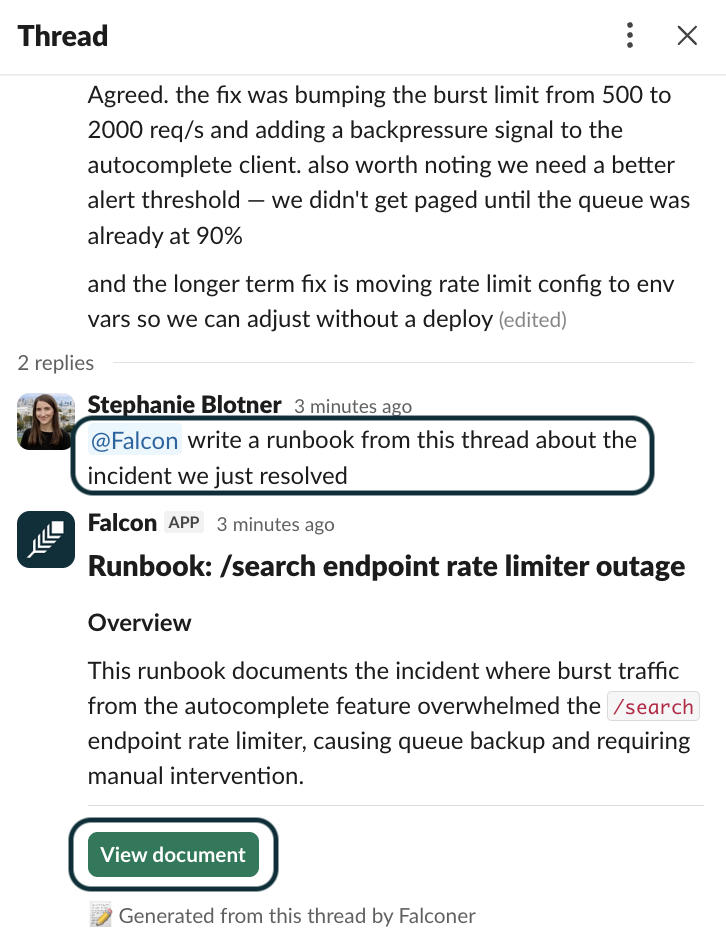
Falconer reads the thread, extracts the resolution steps, and structures them into a reusable runbook.
Reference specific files
Section titled “Reference specific files”Use @ to point Falconer at the exact services, scripts, or config files you want the runbook to cover:
Write a deployment runbook for @src/services/ingest using @infra/deploy.shCreate a rollback runbook based on @scripts/rollback.sh and @infra/terraform/ecsIterate on the draft
Section titled “Iterate on the draft”Once the draft is open in the editor, use the agent in the right pane to refine it:
- Commands — ask Falconer to verify commands against your actual scripts or add missing flags
- Sections — add a prerequisites section, an escalation path, or a rollback procedure
- Audience — adjust the level of detail for a junior on-call engineer vs. a senior SRE
- Edge cases — ask Falconer to identify failure modes or gotchas based on your code
Keep runbooks up-to-date
Section titled “Keep runbooks up-to-date”Once published, Falconer monitors your connected repositories for changes. When a PR merges that affects a service your runbook covers, Falconer flags the runbook and proposes updates — so your procedures stay accurate as your infrastructure evolves.
You can also manually audit your runbooks for staleness at any time. See Find and fix outdated docs.