Leave it to Falconer
Discover everything you can do with Falconer.
Featured use cases
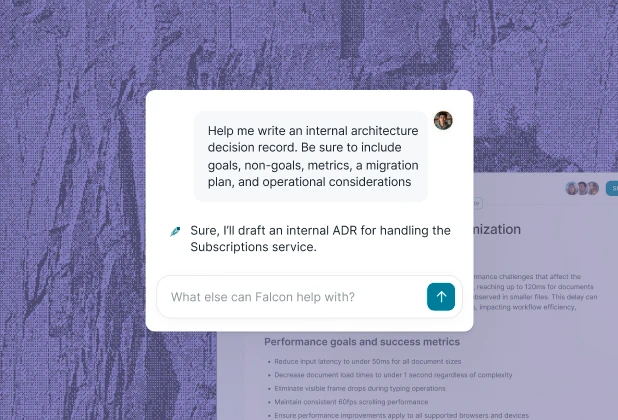 Content generation
Write technical docs instantly
Ask Falconer to generate API documentation, architecture overviews, or onboarding guides using your actual codebase.

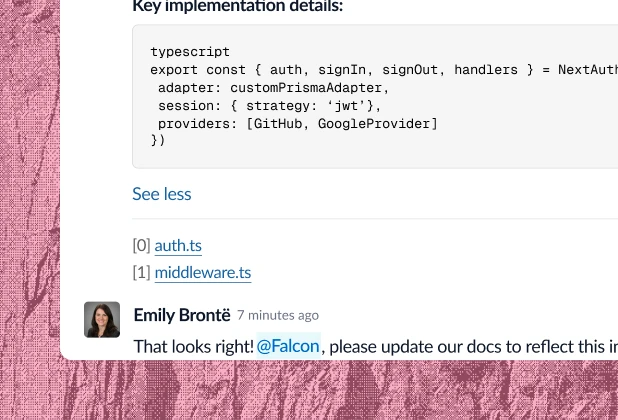 Search & Q&A
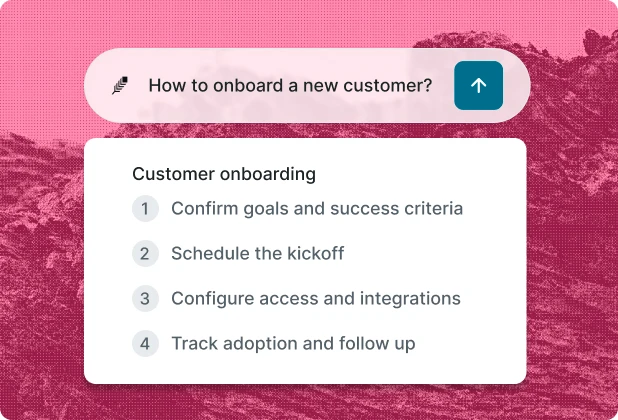
Onboard engineers faster
Get instant answers right where your team works, backed by linked sources.

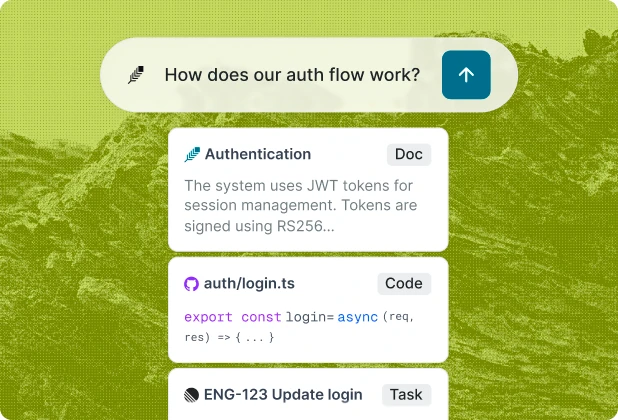 Search & Q&A
Universal search across tools
Search across code, docs, and tasks in one place. Get instant answers with clear source citations.


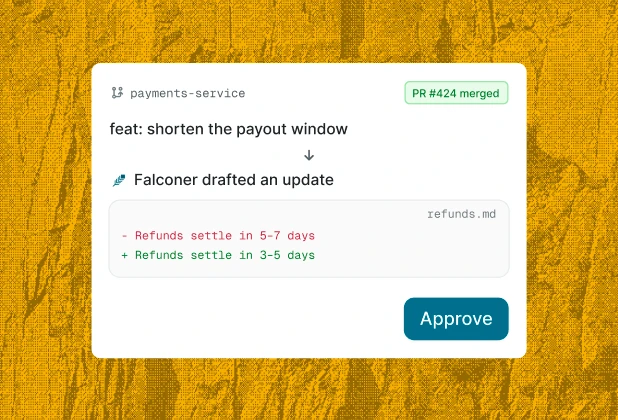 Sync & maintenance
Your docs never go stale
Most tools only stay current if someone remembers to update them. Falconer watches PRs merge, drafts the update, and pings you to approve. No upkeep, no learning curve - the team keeps building while the docs keep up.
 Sync & maintenance
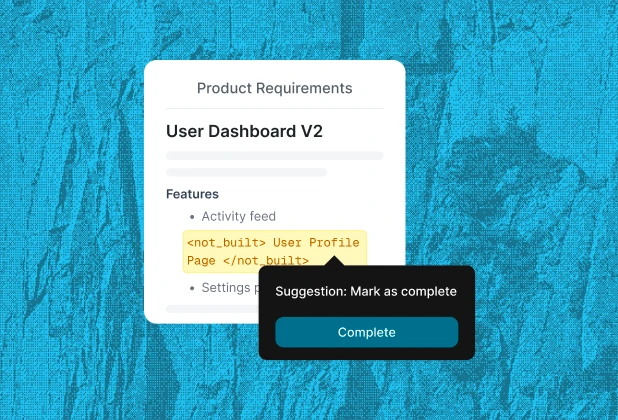
Maintain living requirements
Automatically track implementation progress. Falconer flags outdated requirements and suggests updates based on actual code changes.
 Collaboration
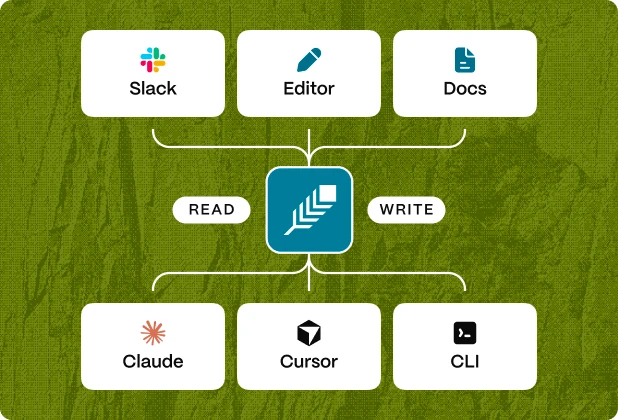
Your team's knowledge compounds
Slack, the editor, Claude, Cursor, and CLI over MCP. Every surface reads from and writes back to the same shared knowledge, so answers get sharper instead of starting from scratch.


 Collaboration
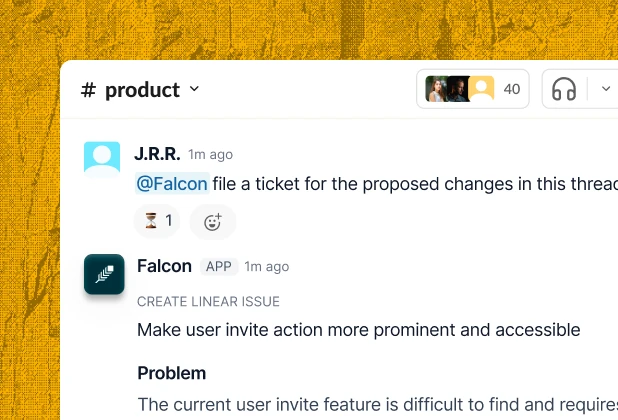
Reference Linear tasks directly
Turn Slack threads into actionable Linear tasks. Falconer extracts context, assigns priority, and generates issue descriptions - no copying and pasting required.
 Knowledge capture
Institutional knowledge scales through change
The context behind how your team works becomes structured, searchable guides. Leave, growth, and hand-offs never cause setbacks and knowledge is always at your fingertips.

 Knowledge capture
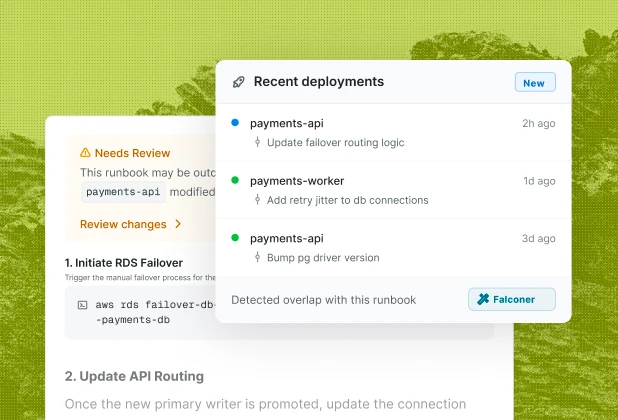
Build self-service knowledge bases
Create help articles, runbooks, and troubleshooting guides. Falconer maintains accuracy by connecting to your codebase and operational systems.

 Search & Q&A
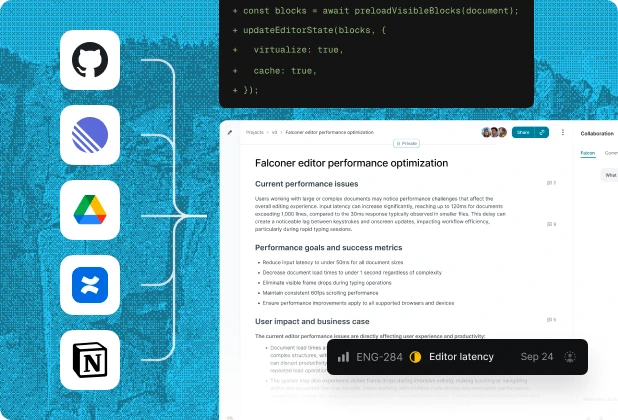
Unlock engineering knowledge for the entire team
PMs, support, sales, and ops ask in plain language and get answers grounded in the codebase, with citations - then turn them into specs, tickets, and replies.
 Collaboration
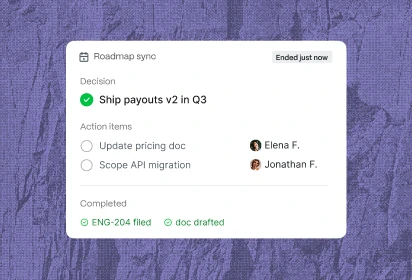
Every decision turns into action
Falconer turns each call into tracked decisions and action items the moment it ends, tags owners, and gets a head start on the work itself: filing the Linear tickets or drafting docs.

 Automation
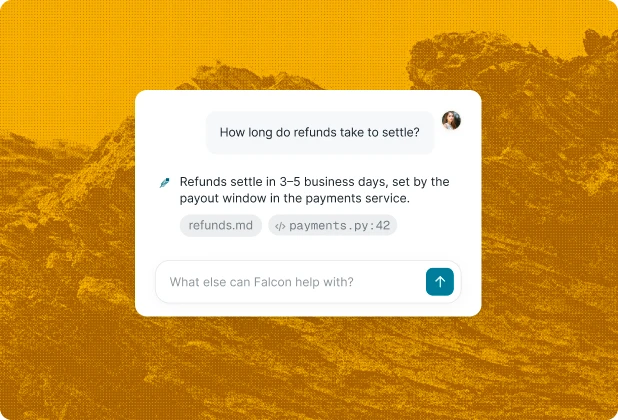
Resolve customer tickets in minutes
Support can ask product questions and get accurate answers straight from company docs and code, without escalating to engineering or waiting for a reply.
Explore by use case
Institutional knowledge scales through change
The context behind how your team works becomes structured, searchable guides. Leave, growth, and hand-offs never cause setbacks and knowledge is always at your fingertips.
Build self-service knowledge bases
Create help articles, runbooks, and troubleshooting guides. Falconer maintains accuracy by connecting to your codebase and operational systems.
Conversations become documentation
Point Falconer at the thread and it turns the back-and-forth into a structured doc, so the answer someone typed is always findable.
Capture decisions as they happen
Meetings and threads become decision logs the moment they wrap, so the reasoning stays on record.
Onboarding guides from your real stack
Generate onboarding docs grounded in your code instantly, so new hires learn the system you actually run.
Own your knowledge without vendor lock-in
Your content stays connected to your real sources and exports as clean markdown anytime, so it's always yours to take with you.
The right answer, the first time
Ask a question and get one cited answer pulled from your current sources - not a list of links to sift through, and not a stale page that sends you down the wrong path.
Decisions stick and stay findable
Tell Falconer to remember a fact or a call, and it recalls it later across the org, with provenance. The reasoning sticks even when the people who made it move on.
Write technical docs instantly
Ask Falconer to generate API documentation, architecture overviews, or onboarding guides using your actual codebase.
Write once, keep every version in sync
Generate audience-specific versions for engineering, sales, and support from a single draft. Edit the source and every variant updates, so five copies stop drifting apart.
Release notes write themselves
Merged PRs and closed tasks become a formatted changelog with links to the changes, so nobody tracks it by hand.
One technical source, every format
Turn a single doc into a blog post, a tweet, and a changelog entry. Update the source and they all follow.
Turn a Slack answer into a polished email
Take an explanation from chat and reshape it into an email, a one-pager, or QBR material.

Turn a wall of text into a table without leaving the doc
Highlight any passage and tell Falconer to make it a table, tighten it, or break it into steps. The rewrite happens in place, so you fix the messy section instead of starting the doc over.
Ship the same guide to a regional team in their language
Ask Falconer to translate a doc and the technical detail survives the trip. One source, and every team reads it in the language they work in.
Unlock engineering knowledge for the entire team
PMs, support, sales, and ops ask in plain language and get answers grounded in the codebase, with citations - then turn them into specs, tickets, and replies.
Onboard engineers faster
Get instant answers right where your team works, backed by linked sources.
Universal search across tools
Search across code, docs, and tasks in one place. Get instant answers with clear source citations.
Trace code history in plain English
Ask when a function appeared, who changed it, or how a file evolved. Falconer answers from real git history, including how the code got to where it is now.
Stop tab-hopping to answer one question
Instead of digging through Slack, Linear, and the repo to figure out how something works, ask once and Falconer searches code, docs, and tasks together. The answer comes back in seconds instead of after three interruptions.
Forward an answer to a customer without second-guessing it
Every response cites the exact files, PRs, and docs it came from, so you can click through, confirm, and forward something you've actually verified.
Ask your diagrams questions
Upload an architecture diagram, wireframe, or screenshot and ask what's going on. Falconer reads the visual and links related docs.
Find the decision behind the doc
Surface why something was decided by pulling from threads, meeting notes, and decision logs.
Search the PDFs you've uploaded
Specs, contracts, and research papers become searchable alongside everything else.
Your docs never go stale
Most tools only stay current if someone remembers to update them. Falconer watches PRs merge, drafts the update, and pings you to approve. No upkeep, no learning curve - the team keeps building while the docs keep up.
Maintain living requirements
Automatically track implementation progress. Falconer flags outdated requirements and suggests updates based on actual code changes.
Catch decay before it spreads
A Knowledge Health view surfaces stale, duplicate, and low-quality docs so you fix them before anyone trusts the wrong answer.
Duplicate docs collapse into one
Falconer flags overlapping pages and offers to merge them, so there's only one right answer instead of three competing ones.
Never maintain two copies again
With GitHub two-way sync, edits in Falconer commit straight back to the markdown in your repo, and changes pushed in GitHub sync back in.
Your doc tree organizes itself
Organize mode proposes a clean structure (moves, new folders, removals) that you review and apply, so you skip the manual drag-and-drop.
Design system docs keep up
Reference the components in your codebase, and when a PR changes them Falconer flags the guidelines that need a refresh, so the design system stays trustworthy without anyone policing it by hand.
Runbooks flag themselves for review
When infrastructure changes, the operational docs tied to it get flagged for review before they mislead someone on-call.
Your team's knowledge compounds
Slack, the editor, Claude, Cursor, and CLI over MCP. Every surface reads from and writes back to the same shared knowledge, so answers get sharper instead of starting from scratch.
Every decision turns into action
Falconer turns each call into tracked decisions and action items the moment it ends, tags owners, and gets a head start on the work itself: filing the Linear tickets or drafting docs.
Reference Linear tasks directly
Turn Slack threads into actionable Linear tasks. Falconer extracts context, assigns priority, and generates issue descriptions - no copying and pasting required.
Meetings end with follow-ups
Action items get extracted automatically after every call, so nothing dies in someone's notebook.
Decisions reach the people who need them
Turn messy Slack threads into clean decision logs your stakeholders can actually read.
See what's on everyone's plate
Ask what's open or what a teammate is working on and get an instant, linked view without switching tools.
Refine together in context
Contextual comments and version history let the team edit and agree without losing the thread.
Settle edits in the doc, not in a 40-message thread
Leave comments inline, see who changed what, and roll back if needed. The discussion lives next to the text it's about, so the doc gets finished instead of debated in Slack.
See value the same afternoon you start
Connect GitHub, Slack, Linear, and your existing docs, with nothing to migrate or rebuild, and the team keeps working exactly where they already do.
Resolve customer tickets in minutes
Support can ask product questions and get accurate answers straight from company docs and code, without escalating to engineering or waiting for a reply.
Routine questions deflect themselves
The Slack agent answers a sizable share of repeat questions from your docs and captures the gaps as new docs.
Changelogs without the manual roundup
Ask Falconer and shipped PRs and closed tasks become a formatted summary, so nobody assembles it by hand.
Turn any repeatable task into a Skill
Write the instructions once in plain language, mark the doc as a Skill, and run it anytime with a slash command. No code, so a PM, support lead, or ops person can build their own automations without waiting on engineering.
Meetings and threads file their own follow-ups
Action items and decision logs get captured the moment a call or thread wraps, then routed to owners as tickets, so nothing waits on someone writing it up.
Work gets done without leaving Slack
File a Linear ticket, draft a doc from a thread, or call the Falconer agent for a cited answer right in the channel.
Connected sources keep answers current on their own
Add your integrations like Zendesk, GitHub, Slack, and Linear once, and every automated answer pulls from live context - no exports, no re-indexing, no stale snapshots to refresh by hand.
A background agent that maintains itself
Falconer watches merged PRs, drafts the doc updates on its own, and pings you to approve. It keeps knowledge current on its own, and there's nothing for you to set up or maintain.
Agents stop committing off of stale context
Every agent reads from the same current, cited knowledge layer, so they work off what's true today instead of guessing.
One agent, every surface
The same Falcon runs on the home page, the editor sidebar, and Slack, and plugs into Claude, Cursor, CLI, and your own agents over MCP and the API on every plan. Ask in one place, refine in another, and context follows you.
Falcon answers with the source attached
Falconer's own agent responds from your real code, docs, and tasks with citations, so you can click through and verify where every answer came from instead of trusting a black box.
Your other agents inherit the same grounding
Cursor, Claude, CLI tools, and custom agents pull cited company context through Falconer over MCP and the API, on every plan, so AI-written code and answers follow how your team actually works.
Stay in flow while the follow-up happens
It files Linear tickets, drafts the doc, or writes the changelog, turning a question into finished work.
Progress reports write themselves
Ask what the team shipped this week and Falconer compiles completed tasks, merged PRs, and doc contributions into a structured summary you can forward as is, no manual roundup.
See knowledge gaps at a glance
The Knowledge Health view shows leaders where docs are stale or missing before it becomes a problem.
Exec summaries from a single question
Turn a Slack ask into a QBR-ready brief or a one-pager for leadership.
Turn raw context into stakeholder briefs
Falconer assembles scattered threads and docs into a clean update for investors, customers, or the board.
Incident recaps anyone can read
Falconer pulls the code changes, logs, and timeline into a plain-language RCA the whole company can follow.
Anyone can find "why did we build it this way?"
Every RCA, decision log, and report stays searchable, so the answer comes from the knowledge base instead of from the one person who was there.