Grok 4.5 vs GPT-5.6 vs Claude Sonnet 5 vs Gemini 3.5 Pro (July 2026)
If you want one model to generate and maintain engineering documentation, the four frontier releases from the last three weeks split cleanly by job. Claude Sonnet 5 and Gemini 3.5 Pro are the two models developers cite most for accurate documentation and code review, which is why Falconer’s Docs-bench runs their output head-to-head on the same codebase. Grok 4.5 is the strongest value pick for code-grounded docs because it was trained alongside Cursor and prices at $2 per million input tokens. GPT-5.6 Sol is the model to reach for when a docs task needs deep reasoning across a large, messy codebase. Skip Claude Fable 5: at $10 / $50 per million tokens it is built for open-ended research, and docs do not need a model that big or that expensive.
TLDR
- Docs-bench runs each model through Falconer Spark to generate a full docs set from scratch, then scores the output with Knowledge Health for accuracy, coverage, and freshness.
- Grok 4.5 (xAI, released July 8) is the cheapest frontier option at $2 input / $6 output per 1M tokens and was trained with Cursor, so it reads code context well.
- Claude Sonnet 5 (Anthropic, June 30) runs at $2 input / $10 output through August 31, then $3 / $15, and ships with a 1M-token context window.
- GPT-5.6 (OpenAI, preview June 26) comes in three tiers: Sol at $5/$30, Terra at $2.50/$15, and Luna at $1/$6 per 1M tokens.
- Gemini 3.5 Pro (Google) is still in limited preview as of July 7 with pricing unpublished, so its Docs-bench result is provisional until general availability.
- Falconer scores every model on the same codebase and the same Knowledge Health config, so the numbers reflect docs quality rather than leaderboard reputation.
What is Docs-bench?
Docs-bench is Falconer’s benchmark for how well a large language model generates and maintains engineering documentation. Each model runs the same task on the same repository, so the comparison isolates docs quality from every other variable.
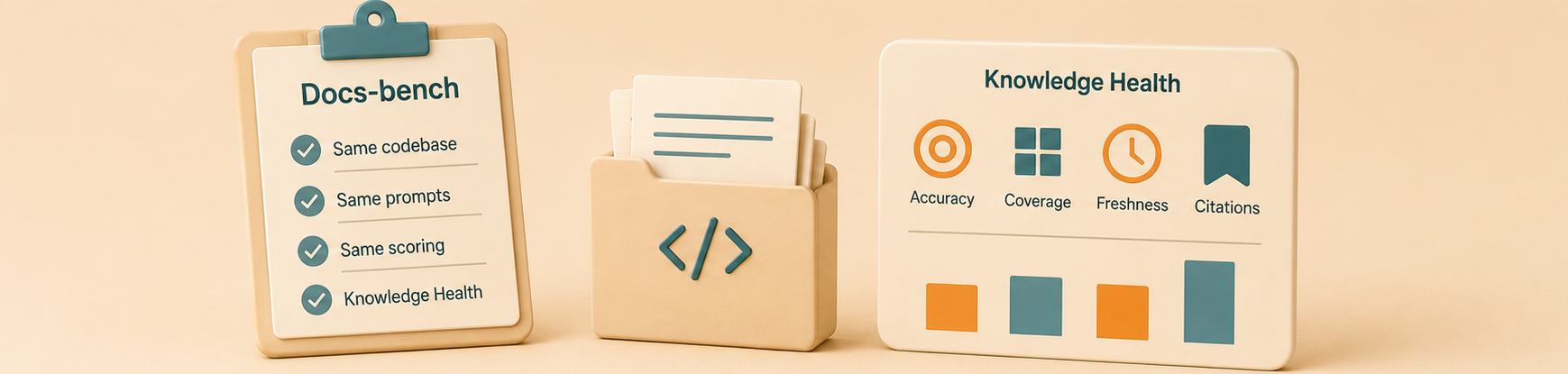
Falconer is a knowledge agent for engineering teams that writes and updates docs as the codebase changes and returns cited answers in the editor, Slack, and AI tools. That split between generating a docs set and maintaining it is the whole point of the benchmark: generation is the easy half, and the score has to reward docs that stay right. Spark is the Falconer feature that generates a complete documentation set from scratch off a live codebase. Knowledge Health is the Falconer scoring layer that grades a docs set on accuracy against the code, coverage of the surface area, freshness, and whether claims carry citations.
The run works in three steps. Each model drives Spark to produce a from-scratch docs set plus a fixed list of guides. Knowledge Health then scores the output. Because the repository, the prompt set, and the Knowledge Health config are held constant across models, the score gap is the signal.
The models in this comparison
All four models shipped inside a three-week window, which keeps the comparison to current defaults rather than legacy versions.
Grok 4.5 is xAI’s latest model for coding and agentic work, released July 8 and made public July 9, and xAI describes it as Opus-class. Claude Sonnet 5 is Anthropic’s mid-tier agentic model, released June 30 to replace Sonnet 4.6. GPT-5.6 is OpenAI’s newest model family, released in a three-tier preview named Sol, Terra, and Luna on June 26 and made public July 9. Gemini 3.5 Pro is Google’s frontier model announced at Google I/O on May 19, targeting a 2M-token context window and Deep Think reasoning, still in limited enterprise preview as of early July.
Specs and pricing
Here is how the four models line up on the facts that hold regardless of the benchmark result.
| Dimension | Grok 4.5 | Claude Sonnet 5 | GPT-5.6 | Gemini 3.5 Pro |
|---|---|---|---|---|
| Lab | xAI | Anthropic | OpenAI | |
| Released | July 8, 2026 | June 30, 2026 | June 26, 2026 (preview) | Limited preview |
| Input $/1M | $2 | $2 intro, then $3 | Sol $5 / Terra $2.50 / Luna $1 | ~$15 (estimated) |
| Output $/1M | $6 | $10 intro, then $15 | Sol $30 / Terra $15 / Luna $6 | ~$60 (estimated) |
| Context window | Large (unspecified) | 1M tokens | Large (unspecified) | 2M tokens (target) |
| Generally available | Yes (not EU yet) | Yes | Preview only | No, preview only |
| Trained with a coding tool | Yes (Cursor) | No | No | No |
Sonnet 5 intro pricing runs through August 31, 2026, then moves to $3 input / $15 output (Anthropic pricing). GPT-5.6 tier rates come from OpenAI’s pricing page and Grok 4.5’s $2 / $6 from xAI. Sonnet 5 also uses a new tokenizer that can map the same text to roughly 1.0 to 1.35x more tokens, so the effective cost per docs run is higher than the headline rate suggests. Gemini 3.5 Pro pricing is an estimate because Google has not published Pro rates; treat any Gemini figure as provisional.

Which model produces the most accurate docs from scratch?
Accuracy against the code is the dimension that matters most, because a docs set that describes functions the codebase does not have is worse than no docs at all. It is also the trait that separates durable technical documentation from a plausible-sounding draft. Sonnet 5 and Gemini 3.5 Pro are the two models developers most often name for accurate documentation and code review, which is why Falconer treats their head-to-head as the reference decision pair. The gap between them is narrow and codebase-specific, so run both through Docs-bench on your own repo to see which comes out ahead.
Which model is cheapest per docs run?
Grok 4.5 is the lowest sticker price among generally available frontier models at $2 input and $6 output per million tokens. GPT-5.6 Luna undercuts it on input at $1 per million but costs the same $6 on output. Sonnet 5’s intro rate of $2 / $10 is competitive through August, though the new tokenizer inflates the real token count for the same source material. A from-scratch docs run reads far more tokens than it writes, so input price and context window carry most of the cost.
Which model handles code context best?
Grok 4.5 was trained alongside Cursor and ships inside it on every plan, so it has direct exposure to how developers read and edit code in an agentic loop. That background tends to help with docs tasks that require tracing a call path or explaining a module in context. Gemini 3.5 Pro’s 2M-token target context window lets it hold a larger slice of the repository in a single pass, which helps on monorepos where the relevant context is spread across many files.
Which model can you actually reproduce results on?
Reproducibility separates a benchmark from a demo. Grok 4.5 and Sonnet 5 are generally available, so a Docs-bench run against them can be repeated by anyone. GPT-5.6 is preview-only through an OpenAI account representative, and Gemini 3.5 Pro remains in limited enterprise preview with no published pricing. Preview-gated models can change under you between runs, so score them with an explicit “as of” date and re-run when they reach general availability.
Where Claude Fable 5 fits
Fable 5 is Anthropic’s Mythos-class model for ambitious, long-running projects, priced at $10 input / $50 output per million tokens, which is double Claude Opus 4.8 and the most expensive generally available rate Anthropic has listed. It was suspended in mid-June under a US Commerce export-control order and restored globally on July 1 after the Commerce Department lifted the controls. It is worth naming precisely so you can rule it out: docs are a grounded, bounded task, not the open-ended research Fable is built for, so a model this large and this expensive is the wrong tool. A cheaper frontier model with an accurate view of your codebase beats Fable on a per-run basis every time. Stick with the frontier four.
See how your model of choice scores
The model you pick sets a ceiling on docs quality. What you feed it decides whether you hit it. Falconer runs Docs-bench on the model you already use, then keeps your docs current as your code changes.
-
Grounded in your code. Generated docs and answers pull from your actual codebase, Slack, and tickets, not the model’s training data.
-
Docs that update themselves. When a PR merges, Falconer reads the diff, finds the affected docs, and proposes the edit, then pings the owner in Slack.
-
Knowledge Health scoring. The same Coherence, Coverage, Freshness, and Density checks behind Docs-bench run on your own knowledge base.
-
Query it anywhere. Reach the same current source from the editor, Slack, and coding agents like Claude Code and Cursor over MCP.
See the latest Docs-bench results.
FAQ
Which AI model is best for writing documentation in 2026?
For accurate from-scratch documentation, Claude Sonnet 5 and Gemini 3.5 Pro are the two models developers cite most, and Falconer’s Docs-bench scores their output head-to-head on the same codebase. For code-grounded docs on a budget, Grok 4.5 is the strongest value at $2 input per million tokens.
Is Grok 4.5 good for coding documentation?
Grok 4.5 was trained alongside Cursor and ships inside it, so it reads code context well and is the cheapest generally available frontier model for docs tasks. xAI describes it as Opus-class.
How much does it cost to generate a full docs set?
Cost depends mostly on input tokens, since a from-scratch run reads far more than it writes. At current rates a run is cheapest on GPT-5.6 Luna ($1 input) and Grok 4.5 ($2 input), and most expensive on Gemini 3.5 Pro (estimated $15 input).
Can I reproduce Docs-bench results myself?
Yes for Grok 4.5 and Claude Sonnet 5, which are generally available. GPT-5.6 and Gemini 3.5 Pro are preview-gated as of July 2026, so results against them are provisional until general availability. Falconer publishes a fixed Knowledge Health config so runs are comparable.
Should I use Claude Fable 5 for documentation?
No. At $10 input / $50 output per million tokens, several times the frontier four, Fable 5 is built for open-ended research, not the grounded, bounded task of writing docs. A cheaper frontier model fed an accurate view of your codebase produces better docs per dollar, so there is no docs case where Fable is the right call.
Ready to get started?
Create an account and start building your knowledge base — no contracts or credit card required. Or, contact us to design a custom package for your team.
Ready to get started?
Create an account and start building your knowledge base — no contracts or credit card required. Or, contact us to design a custom package for your team.